The ferry system in Greece is the biggest and most efficient in the world. During summer, there are over a hundred ferries connecting the Greek Islands and mainland ports at any given time. The boats are well-maintained and have an excellent safety record. Using ferries in Greece is a part of the full Greek Island experience.
Some ferries are huge and are like cruise ships, with restaurants, cabins, and shops onboard, while ‘fast ferries’ are usually smaller and, well, fast. Each island group is serviced by certain ferry companies, and the groups themselves rarely interconnect.
The ticketing agent that we use and recommend is Ferryhopper. Their booking engine is the most extensive and intuitive and gives you the most options, including alternate routes.
How Do You Figure Out Your Routes?
Planning your route accurately may be what your entire holiday trip hinges on. After all, if you don’t find the right route for one or more of your island hopping stops, you may face some delays or have to support additional costs, or you might even end up on the wrong island ( this happens more than you would think).
Fortunately, with a good online booking platform like Ferryhopper, you can look up any route between the various Greek islands you want to visit and get instant information, quotes and schedules for ferries and ferry companies that are available within your allotted time. They will even give you indirect routes which are often a great solution.
All you have to do is enter the information about the route you want to take (for example, Santorini to Mykonos), the date of your trip and whether you want a one-way or return ticket.
Ferryhopper also have a fantastic app which is something the other ferry companies are well behind on. You can store all your tickets in the app, usually checkin online and tickets often have QR codes so they are simply scanned as you board, no need to print anything! The app also allows you to track you ferry so you know when to head to the port. No time wasted sitting around and it also means you shouldn’t get on the wrong ferry ( that happens now and then too)
Further reading : A complete guide to Island Hopping Routes in Greece
Booking Your Ferry Tickets for Greece
For most ferries you can book ferry tickets online, or you can buy tickets right before you get on the ferry at a ticket office at the harbour. The problem with the latter, however, is that you might not find available tickets, since most people get theirs online, and most ferry companies in Greece (although not all) offer online booking options.
If it is June – September and/or a public/religious holiday it is best to book your tickets in advance.
The only time when booking offline should be an option is when you’re visiting a remote or lesser known island which doesn’t have an online option, such as the car ferries from Paros to Antiparos or Milos to Kimolos. These tickets are usually purchased onboard or at small ticket office at the dock.
Frequently asked questions about ferries in Greece
Q. How do I work out which islands to see and what the different routes are?
A. This article goes into a lot of detail about the various island groups and the routes that cover them. It also goes into detail about a number of the islands on those routes.
Q. Why can’t I find a route for my dates?
A. Schedules are not usually finalised until just before Greek Easter each year – usually March, but sometimes earlier and sometimes later. Keep checking.
Q. Do the Ferries only run between the Greek Islands?
A. No. You can also get the ferry to and from Turkey and Italy, and some small ferries also run between Mainland towns. Many come and go from Athens, of course, but also from Thessaloniki, Patras, Igoumenitsa and a few other mainland ports too.
Q. Can’t I just get a ticket on board?
A. Only the smallest ( and often unpublished) ferries sell tickets on board. Otherwise, you will need to buy tickets either online, from the various ticketing agents around the main ports, or from your travel agent.
Q. My online ticket doesn’t have a barcode. Does that matter?
A. If you need to have a paper ticket, your ticket/email confirmation will inform you. Usually, you will need to get a paper version of the ticket at the ticketing agents in the ports before you embark. This can cost a couple of euros.
Q. Is First Class or Business Class worth it?
A. Many people will say no. If it is a short trip and/or you are on a tight budget, then regular economy seats are usually fine. Other people love having an allocated seat in a particular section, like Business or VIP, and typically they have a private lounge and bar too.
Your boarding and disembarking procedure will, however, be the same as everyone else’s and in fact on many ferries the premium seats end up boarding last as they are upstairs.
Personally, we have found Business Class is worth it on the big ferries like Bluestar but not on the smaller ones.
Q. Is there always allocated seating?
A. No. The bigger ferries will have allocated seating for all classes, but in Economy, people largely ignore the seating and sit wherever they like. There is not usually any allocated seating on the outside decks. There is usually allocated seating in Business and First Class.
Q. If I book one berth in a cabin will I be sharing with others?
A. Possibly. If you book one berth in a 4 berth cabin, you may end up with 3 companions. If it is off-season or shoulder, chances are you may end up with 1 or 2 people, or have the whole thing to yourself, but the only way to guarantee this is to book the entire cabin. Blue Star Ferries has 1-person cabins on most of their ships.
Q. Shall I just wait and buy my tickets when I arrive?
A. If it is the off-season, then most of the time that will be fine. It’s rare for ferries to book out unless it is July/August and/or a special holiday. If there are no seats left ask if there are any cabins. For groups of 3 or more, this may actually be about the same price.
Q. Can I check in online?
A. Yes, if you use Ferryhopper, you can usually check in online, and then you are given a QR code which is scanned upon entry.
Q. What do I do with my luggage on the ferry?
A. All of the ferries have well-marked luggage storage on the lowest level where you board, usually before the car storage. You simply put your bag in the area marked for your next destination. If you have valuables within your luggage, take them with you or take your entire bag, although you may need to traverse stairs and/or escalators.
Some people insist on dragging their suitcases up the stairs, but not only is this a safety hazard, but also it really slows everyone down. Honestly, leave them in the garage. They are patrolled and there are cameras – I’ve actually never heard of a single incident other than people picking up the wrong bag ( just like airports – make sure your bag is clearly recognisable).
Q. What ferry do I book if I am prone to seasickness?
The biggest one on offer. The smaller ferries, such as Seajets, are often less able to deal with inclement weather and can be very unpleasant in rough seas. On most of their ferries, there are no outdoor areas, and you usually can’t open the windows. Keep in mind ‘Seajets’ is a brand, however, not a single ship, and some are big while others are small. You can check their fleet on their website.
The big ferries like BlueStar and Anek, even some of the biggest Seajets, have modern stabilisers and are much better in bad weather. They may be slower, but are also much more reliable and less prone to delays and cancellations.
When booking, look for the car symbol next to the ferry name; if it takes cars, it is usually a big ferry.
Q. Can I take my pet on the Ferry in Greece?
A. There are a limited number of cabins on Blue Star, Minoan and Anek that are pet friendly, and they are usually at no additional cost. There is typically a number of kennels available, and dogs can be walked on decks as long as they are on a leash and muzzled.
On other ferries like Seajets you are usually able to take your dog to your seat as long as it is on a leash and muzzled.
Q. How much time should I leave between ferries in Piraeus?
A. At least an hour. Piraeus is the biggest port in Europe and is quite spread out. There are 9 Gates, and if you disembark at nine but your next ferry departs from 1, you will need at least 30 minutes to walk there, or catch a taxi. It’s also important to let any drivers know your expected gate number, too, or they can have a lot of trouble finding you.


A Blue Star Ferry public lounge

A 4 berth Blue Star cabin
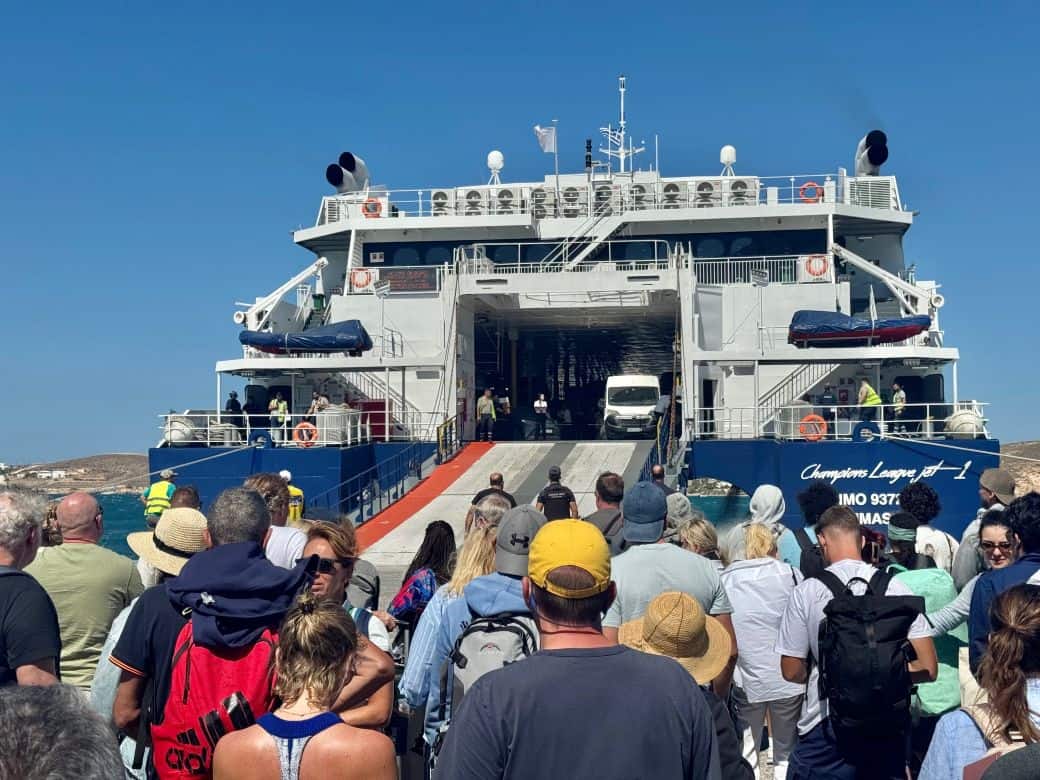

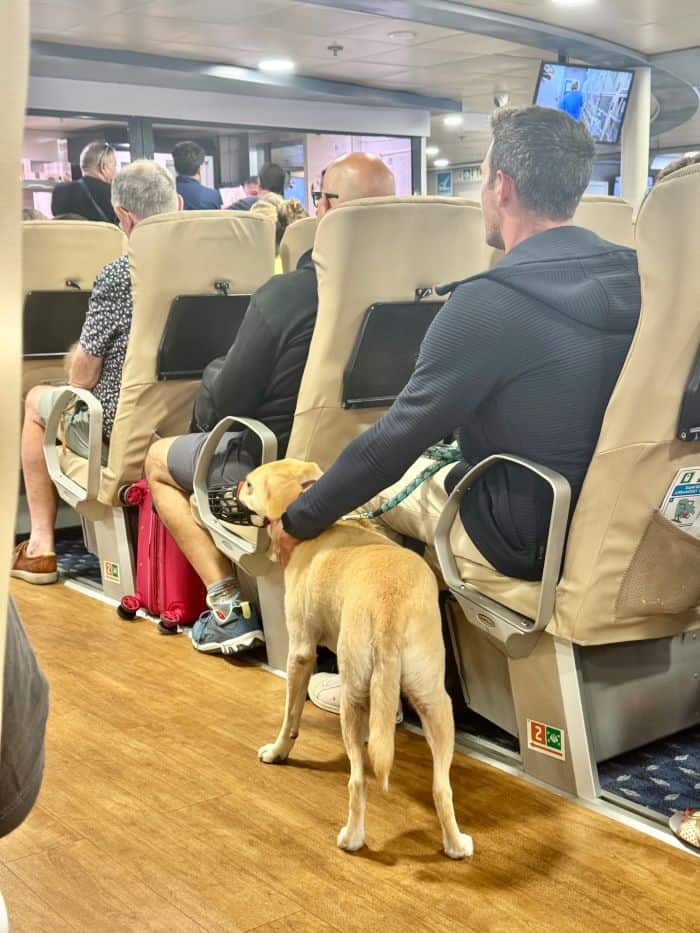
Champions League Jet 1 economy

Super Runner in Sifnos

Seajets in Paros

The small car ferry to Antiparos from Paros

Luggage on a busy Blue Star leg

Ferries to Greece in Turkey

An outdoor deck on a Blue Star Ferry